









Companies that deal with cross-border transactions or have overseas branches and subsidiaries face continuing and complex challenges in financial reporting and control. Foreign exchange (FX) fluctuations, multi-currency consolidations, and multiple tax regimes make business reporting and consolidations cumbersome. Data fragmentation across country systems is also a common challenge. These challenges complicate budgeting, reporting and the strategy process. This article looks at how MODLR solutions and features support international businesses, especially in dealing with multi-currency transactions and tax reporting.
Here’s what we cover in the article:
- How MODLR Helps with Common Challenges in Accounting for International Business
- Challenge 1: Foreign Exchange (FX) Fluctuations
- Challenge 2: Complex Intercompany Transactions
- Challenge 3: Consolidation Across Jurisdictions
- Challenge 4: Multiple Tax Regimes and Rules
- Challenge 5: Data Fragmentation Across Systems
- Challenge 6: Complications in Sensitivity & Scenario Testing
How MODLR Helps with Common Challenges in Accounting for International Business
International business is complicated, but despite the many challenges companies find that its benefits far outweigh the disadvantages. Routine budgeting and reporting and the strategy process are complicated by fluctuating FX rates, changing tax rules and shifting economic conditions. These businesses need supportive accounting systems and processes that can deal with such challenges quickly and effectively.
Let us take each common challenge and look at how MODLR can make things easier, smoother, and faster, saving both time and money in the process. Calculating these cost benefits would make the purchase evaluation of MODLR relatively easier and simpler.
Challenge 1: Foreign Exchange (FX) Fluctuations
Exchange rates keep changing daily, affecting the value of transactions, business consolidations, and financial results.
For example, a UK-based company invoices in USD but must report in GBP. The rate changes between the two currencies impact their revenue reporting.
Solution: Multi-Currency Consolidation
MODLR’s multi-currency consolidation module automatically applies daily, monthly, or custom FX rates to transactions and the balance sheet. It integrates rate feeds, revalues balances at the reporting date, and runs what-if scenarios for impacts of foreign exchange volatility.
Challenge 2: Multicurrency Intercompany Transactions & Cashflows
When a business has one or more subsidiaries in different jurisdictions, intercompany sales, loans, and transfers must be recorded and then eliminated in making consolidated accounts.
For example, a Singapore-based parent company sells goods to its Australian subsidiary, and they both have different tax and currency requirements.
Solution: Financial Close & Consolidation
MODLR’s Financial Close & Consolidation module automates intercompany eliminations. It matches transactions between entities, removing duplicate entries and ensuring accurate intercompany eliminations while maintaining an audit trail.
Challenge 3: Consolidation Across Jurisdictions
Combining financial results from countries with different accounting standards and local statutory adjustments can be a daunting task. Completing international consolidations with accuracy and speed is a recurring challenge.
An example is the need to merge reports from a subsidiary that reports under local GAAP with a parent company reporting under IFRS.
Solution: Multi-GAAP Mapping & Transformation
Multi-GAAP mapping is the ability to support financial reporting across different accounting frameworks by mapping local GAAP structures to a standard or desired group format such as IFRS. You can use MODLR’s consolidation and transformation tools to map local accounts to a group chart of accounts and apply IFRS adjustments to make consolidations in real time.
Challenge 4: Multiple Tax Regimes and Rules
Business units that require consolidation may have different VAT/GST rates, withholding taxes, and corporate tax laws, all adding complexity to the recording of transactions.
For example, a company that sells to both EU and US customers is required to apply EU VAT in some cases and US state sales taxes in others.
Solution: Tax Calculation Rules Engine
MODLR’s scenario planning module includes a tax calculation rules engine for use within financial models.
It applies tax rates based on jurisdiction tags in transactions and automatically calculates liabilities while updating financial statements.
Challenge 5: Data Fragmentation Across Systems
Business units in different countries could be using multiple enterprise resource planning (ERP), accounting, and point-of-sale (POS) systems, inevitably leading to siloed data. This challenge is particularly severe for companies that grow with mergers and acquisitions, rather than organically.
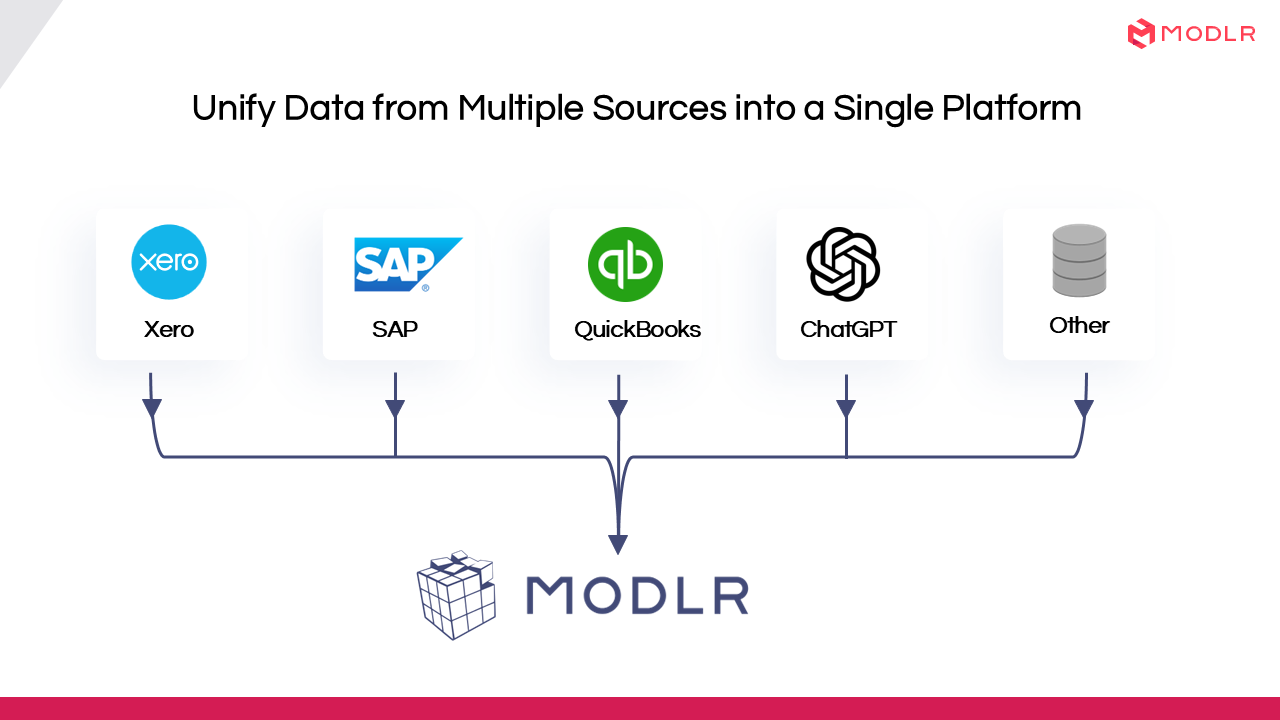
For example, one subsidiary may be using Xero, while another SAP, and a third has been using QuickBooks. All of these need to be integrated together to enable automation of accounting consolidation and reporting
MODLR Solution: Data Integration Connectors
Recognising the reality of these complications, MODLR offers data integration connectors that enable our clients using Xero, QuickBooks, SAP, MYOB, and other services to smoothly integrate their data. Their role is pulling data from a variety of sources into a unified data model, effectively providing our clients with consistent reporting formats and calculations and the assurance of accuracy and control over their data.
Challenge 6: Complications in Sensitivity & Scenario Testing
In the current volatile business environment, conducting sensitivity analyses and scenario testing is a challenge. But the magnitude of the challenge grows exponentially when a business must also carry out scenario and sensitivity tests for its international business units. Even if the local businesses and subsidiaries conduct their own testing, to make sense as a whole, it requires an understanding of potential changes in FX rates, tax rules, and varying economic conditions that can affect consolidated business results.
For example, what could happen if the USD weakens 10% against the EUR and, at the same time, VAT rates rise in the EU?
MODLR Solutions: Scenario Planning & Value Driver Trees
MODLR’s scenario planning module and value driver trees have the capability to adjust FX and tax drivers instantly to model their real-time financial impacts.