










This is a guest article by Paul Barnhurst, The FP&A guy, an esteemed writer, podcaster and contributor in all things FP&A.
The term digital transformation has been thrown around by consultants as the answer to many of the challenges finance has faced over the last decade. Too much data? Too many disparate systems? Wasting too much time with manual processes? All you need is a good digital transformation.
Despite the emphasis on digital transformations, many finance departments (and by extension many FP&A departments) still fail to provide the value that CEOs and CFOs rightfully expect.
At the start of the digital transformation journey, CFOs are looking to replace their inefficient processes, rooted in legacy software, with ones that foster an agile approach to FP&A and work to:
- Streamline and automate month-end close
- Provide predictive insights to business leaders
- Automate repetitive, manual tasks
- Support quick what-if analysis and scenario modelling
- Deliver financial and operational reporting in real-time
For FP&A departments searching for the right tool to fuel their digital transformation, the above points are key to ensuring your digital transformation is set up for success. However, choosing the right tool is not all it takes to guarantee the progress of your digital transformation efforts. Below, we will discuss several tips that will increase the likelihood of your digital transformation being successful.
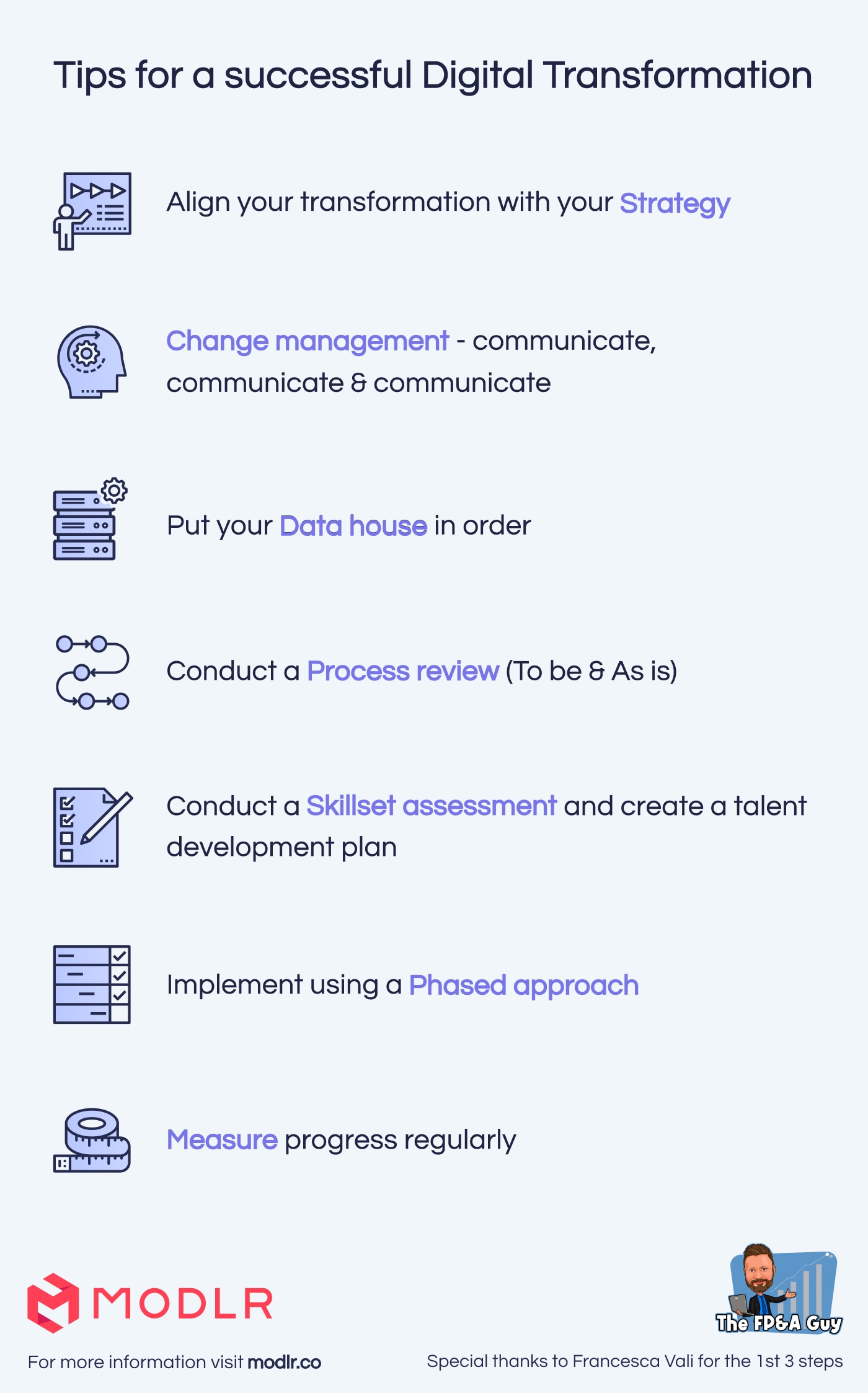
1. Strategy
2. Change Management & Stakeholder Involvement
3. Data House in Order
4. Process Review
5. Skillset Assessment and Talent Development
6. Phased Approach
7. Measure Regularly
Credit to Francesca Valli for introducing me to the first three (Strategy, Change Management, and Data House in Order)
1. Strategy
At the start of any digital transformation, a company must ensure they have a good strategy for transforming the organisation. This goes beyond the tactical steps and requires one to think about how your financial resources, skills, and processes will help enable value-creation for the business as a whole. Writing down what your strategy will be and more importantly how you will implement this strategy is critical. Having a strategy will help guide you throughout the process.
2. Change management
Change management is about having the support of senior leaders and communicating, communicating and then communicating some more. Communication must be two-way as it is not about just telling staff that a change is coming but working with them to get them onboard.
Another important part of change management includes involving stakeholders in every step of the process. Too often projects fail because finance implements a new project in a vacuum. I recently learned of a finance leader who spent seven months implementing a popular planning tool only to be told by the business that they did not like the tool and would not use it. They told finance they were welcome to use it but they could not expect the business to use the tool. In this example, seven months of work and a lot of money could have been saved if the finance department had involved all stakeholders in the process from the beginning.
3. Data house in order
A successful digital transformation requires one to put one's data house in order. New systems and processes on their own do not fix data. When implementing new tools it is important you review the current data, the issues with the data, and ensure any digital transformation addresses the gaps in the current data. This may require establishing data dictionaries and master data management tools before implementing a new tool or in conjunction with a new tool. I worked on a project where this was the case and as part of our transformation process, we made sure to include a robust process to get our data house in order. This process included implementing a customer master data system and fixing our Salesforce process to ensure our data was in order so we could benefit from our digital transformation.
4. Process
When it comes to successful digital transformations one should never just take the existing process and automate it. Always take the time to map the current process and the to-be process. Be sure to involve all process owners in both the current and to-be processes to ensure you have an understanding of how these changes will impact everyone involved. Failure to map current processes, or being unwilling to change processes, is one of the quickest ways to ensure your digital transformation falls short of expectations.
5. Skillset assessment & Talent development
Companies often forget that implementing new tools require different skills to manage and maintain. I have often heard of a tool only being used until the first time a major change needs to be made, then the team returns to Excel because nobody on the team has the skills to update the tool and hiring a consultant is too expensive. This is why it is important to do a skill assessment as part of your digital transformation. Once you have assessed the skills of a team, compare that to the skills required after your transformation and develop a plan to ensure you have the skills needed for the transformation to be successful.
6. Phased approach
Studies have shown that when tools are implemented in phases they have a much better chance of being successful. Many finance tools have multiple modules and coming up with a strategy and timing for implementing each module in a phased approach will increase the chance for success. This provides time to train people on the different modules and makes it easier to implement change management at each step in the process.
7. Measure regularly
“Where performance is measured, performance improves. Where performance is measured and reported, the rate of improvement accelerates.” The above quote by Thomas S. Monson summarizes why measuring progress and performance against key objectives is so important. Measuring and then reporting those measurements allows for course correction when things start to go off track. When establishing objectives for your measurements, focus on the key objectives of the project, they should be the 3-5 things that will drive 80% of the project’s success. Once you establish your measurements, define how often they will be captured, reported, and reviewed. The key to success is measuring, reporting, reviewing, and then taking corrective action - when necessary - based on the measurements.
Conclusion
Although a digital transformation’s success does heavily rely on choosing a tool that works best for all levels of your FP&A department, it takes something more to wholly transform your organisation. Transformations also require analysing your processes, advancing your skillsets, developing your culture and enriching your people. FP&A departments that focus on all areas of a transformation are in a much better position to become the creators of value that management needs them to be.
Even though transformations are not only about selecting the "one right" tool which rarely exists. It is important to ensure you have a tool that can aid you in the below points:
- Streamline and automate month-end close
- Provide predictive insights to business leaders
- Automate repetitive, manual tasks
- Support quick what-if analysis and scenario modelling
- Deliver financial and operational reporting in real-time
If you do all the other steps right as part of your digital transformation but fail to select a tool that is capable of meeting your business needs, your transformation is unlikely to succeed. One tool that is designed to help meet the needs of FP&A departments in transforming and automating the way they work with data is MODLR.
See MODLR’s FP&A solutions in action
If you are interested in learning more about MODLR and discovering how the CPM Cloud can support your organisation in its Digital Transformation, you can schedule a demo here.